
One might not think that the best time to sow and plant meadows in Finland would be late October. However, that is exactly so. Regardless of the potential rain, wind and cold, we were numerous in digging the earth and spreading the seeds, following the instructions by experienced meadow establishers from the Wild Zone association.
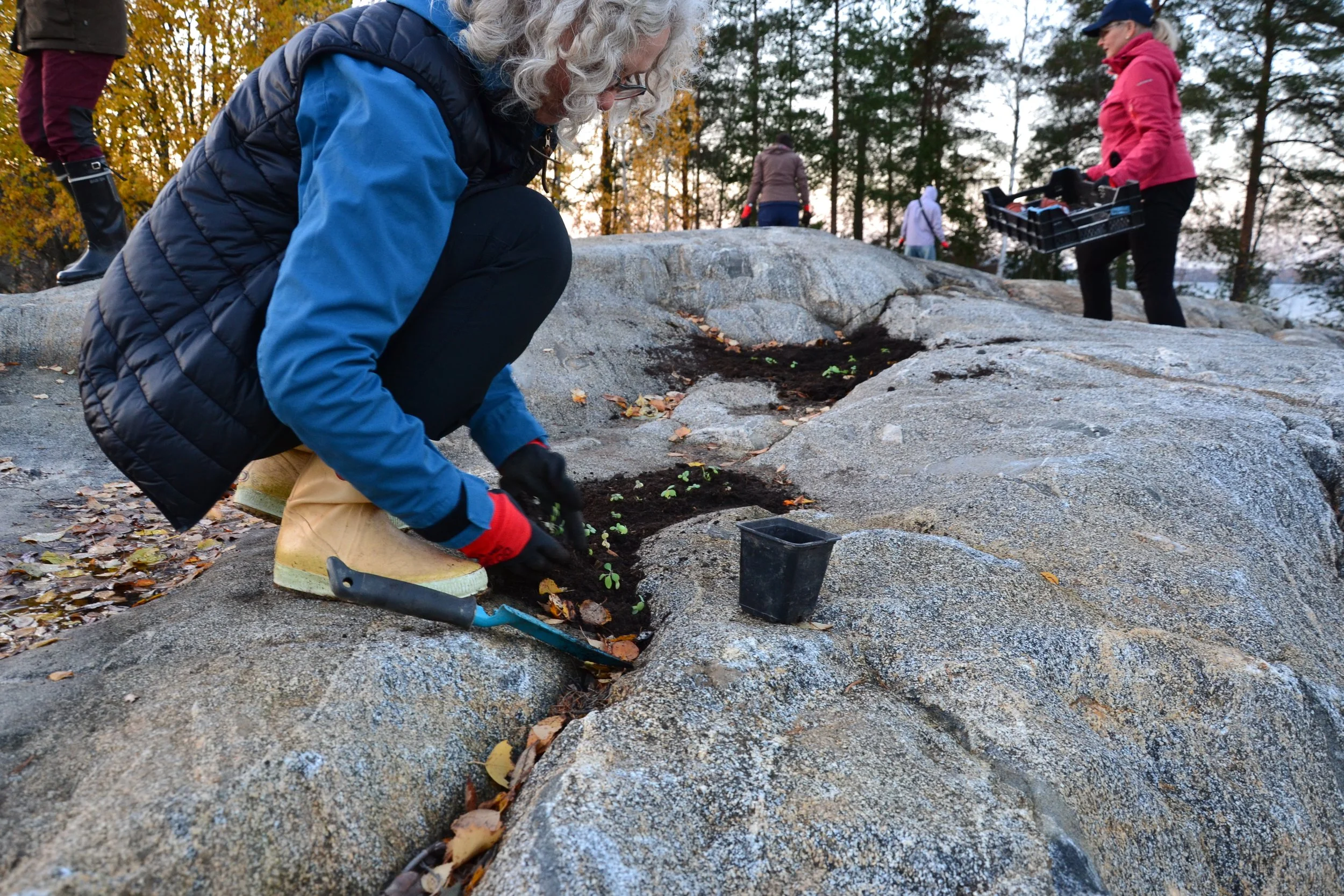
In Härmälänranta some seedlings were planted also on top of the beautiful rocks surrounded by the future meadow. Photo Lauri Linnavirta.
The work was spread to two days and locations in Tampere. We started on Wednesday October 21st in Nekala, just in front of Nekalab, a culture center that has been established this year to a historical school building. Coming together after work at 5 PM allowed us about two hours of enough daylight to act on the field. Close to 30 volunteers and 10 people from INNATURE compiled quite a big group in relation to site, which is why we took the first day as a warm-up and rehearsal of the practice for the four times larger site of the next day.
Lauri Linnavirta and Emmi Seppänen from Wild Zone had already placed the small seedlings to their spots in the meadow. The area was also divided into sectors, where different types of plants would be sown. After shortly presenting the project and some key people, like Katja Maununaho guiding the Meadow Lab and Anna Levonmaa from the City of Tampere responsible of the green areas of the neighbourhood, we got into the practical hints regarding the meadows. For planting, first thing was not to get confused, if there seemed to be no plant as such in the box: we were planting mostly roots of the plants, as the autumn is already so far. Another guideline was to make sure the planted thing does not remain higher than the surrounding soil, in order not to risk the roots drying. As the meadows we are establishing are mostly dry and nutrient poor, the soil is basically gravel.
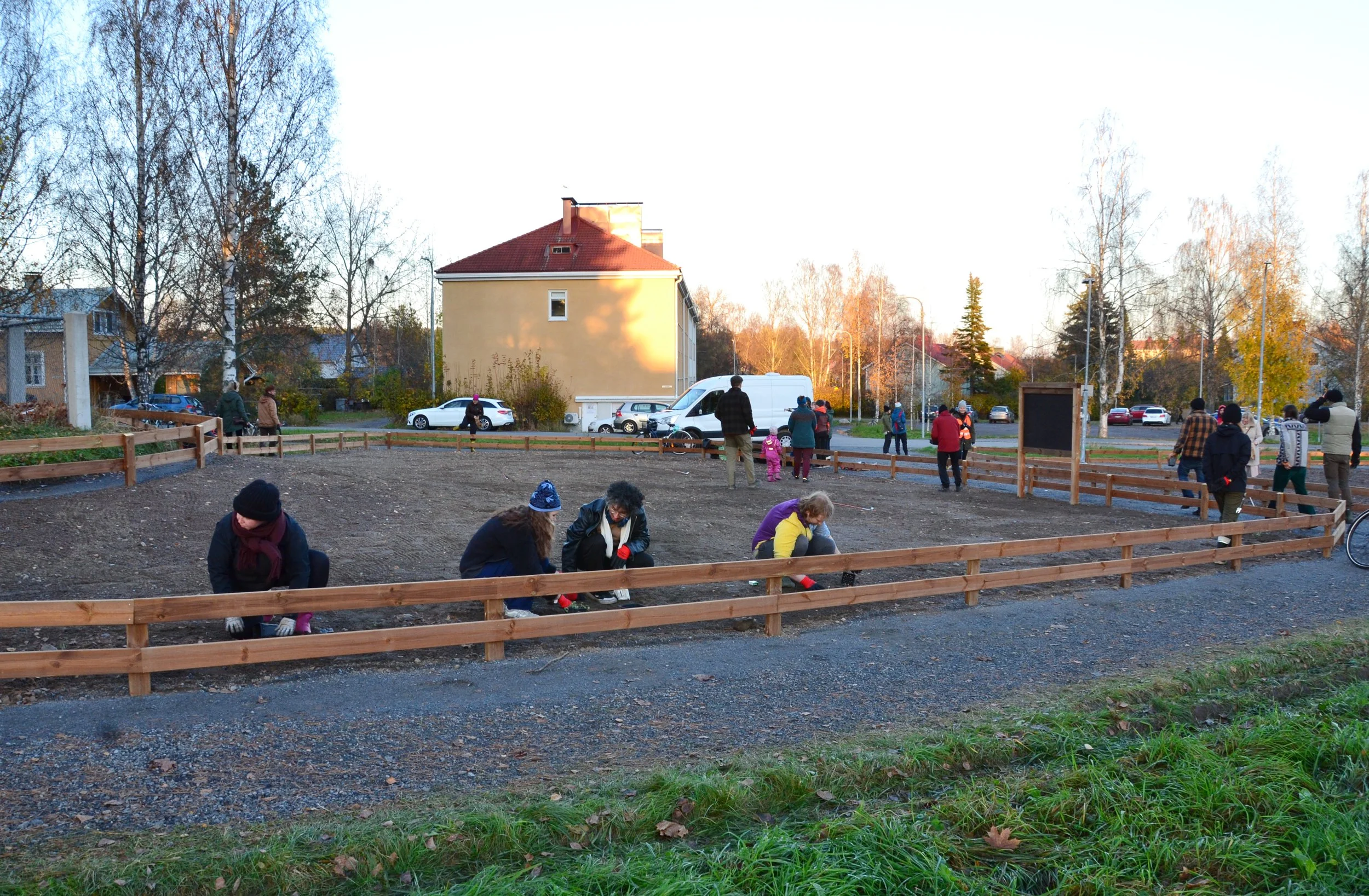
In Nekala the meadow comprises of two small sites. Photo Lauri Linnavirta.
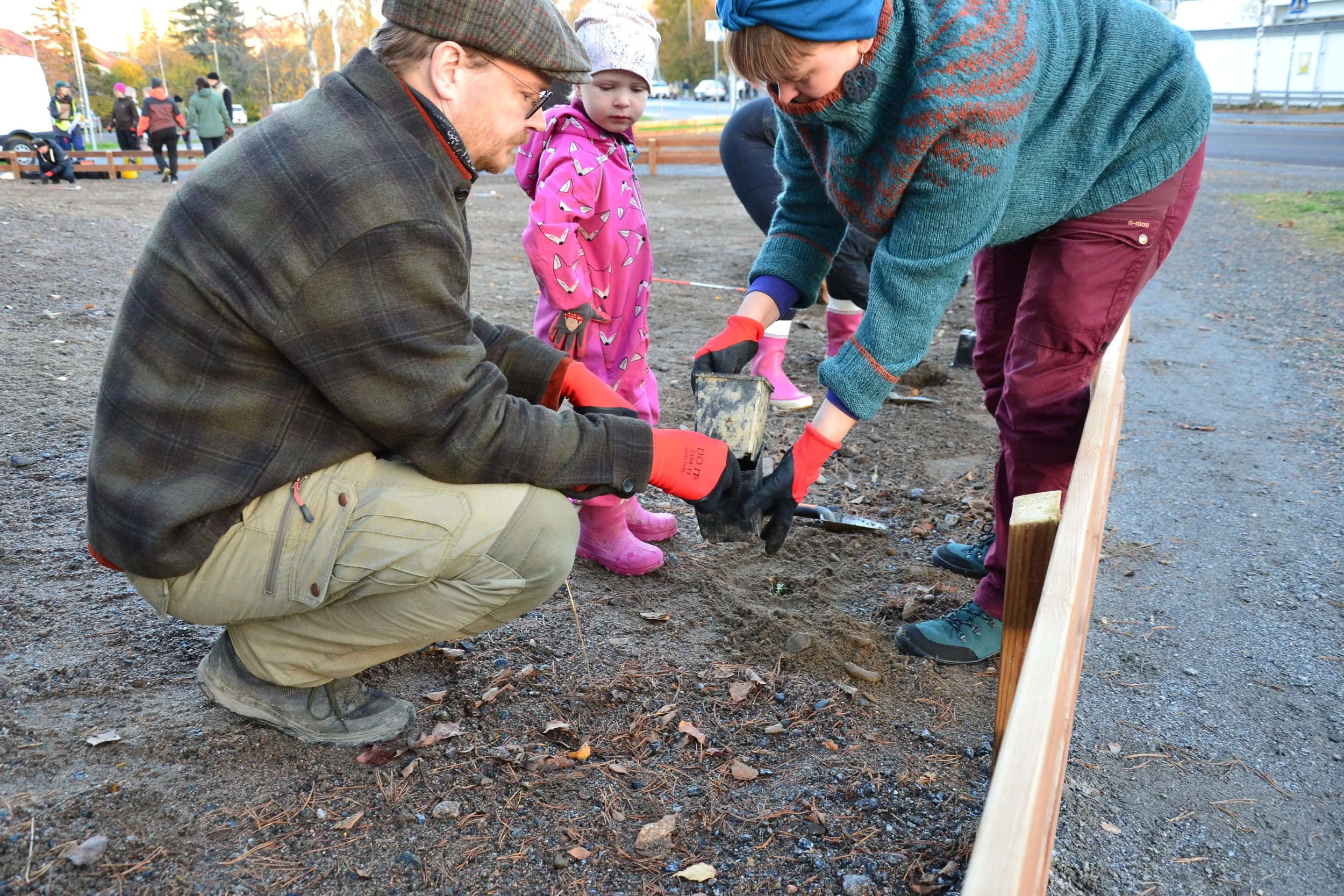
This time of the year the thing planted is mostly about roots. Photo Lauri Linnavirta.
Those who took on the sowing, got a paper back with the name of the plant, and detailed instructions on where to sow the seeds. Lauri and Emmi had planned the meadow so, that each plant could get optimal possibilities. For example, close to edges, there are plants that make quickly a thick buffering zone, to prevent other easily spreading species. These meadows concentrate on natural plants, such as Nottingham catchfly, Zigzag clover and Bird's-foot trefoil, whose seeds are collected near-by and who support a variety of rare or endangered species, such as the moth Anacampsis fuscella.
After sowing we visited and discussed three other meadows close by, that are earlier projects of Wild Zone, established for example in collaboration with the local school. These allowed us to see, how our meadows might look in future years. We also discussed things that have now been done differently, after learning from earlier experiences, such as paying attention to the soil being as poor of seeds in itself as possible. We ended our evening around tables at the restaurant of Nekalab, with sandwiched and warm drinks, Nekalab being one of our collaborators with the meadows.
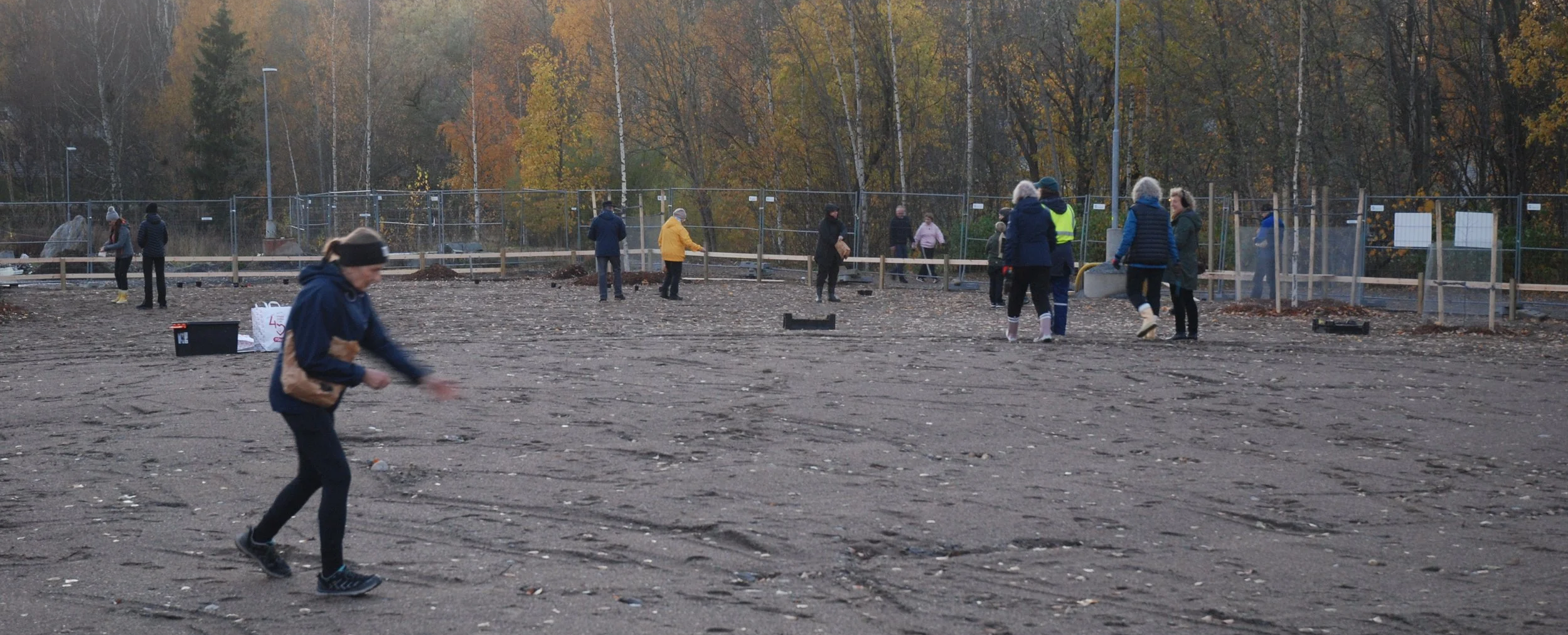
In Härmälänranta the area of the meadows is more the size of a football field, meaning there was enough to do for us all. The meadow will have different atmospheres, from more moist parts with threes to low and dry plants. Photo Katja Maununaho.
Next day in Härmälänranta was full action. At the beginning, artist Henriikka Kontimo reminded us about the box now installed next to the signpost, to collect sound memories in relation to nature. She also had envelopes for all of us, for a personal art experience at home. The spots to create seating places next spring were already visible and shortly discussed. We also had greetings from the City of Tampere by Kaisa Rantee, sharing that this is going to be one of the high value meadows of Tampere and thus also taken especially care of.
About the same amount of people as in Nekala, including children, grandmothers and grandfathers, as well as some dogs, were at work for about two hours. Dogs were not though allowed to the meadows. There was much more to plant, as well as to sow, which is why there was also Laura Valkama from Wild Zone to guide us. The work became very meditative, even performative, as the group moved on a big site. The site belongs to a park in between a housing area and a lake, and there were many curious eyes from the windows and passers-by looking at what was going on. While sowing, we found many to be interested in learning how to collect these seeds and where, resulting into us starting already to plan events for seeds collection. During the next years we will need additional sowing, as we see which parts of the meadow will need support. Future work includes also removing unwanted plants and possibly growing seedlings.
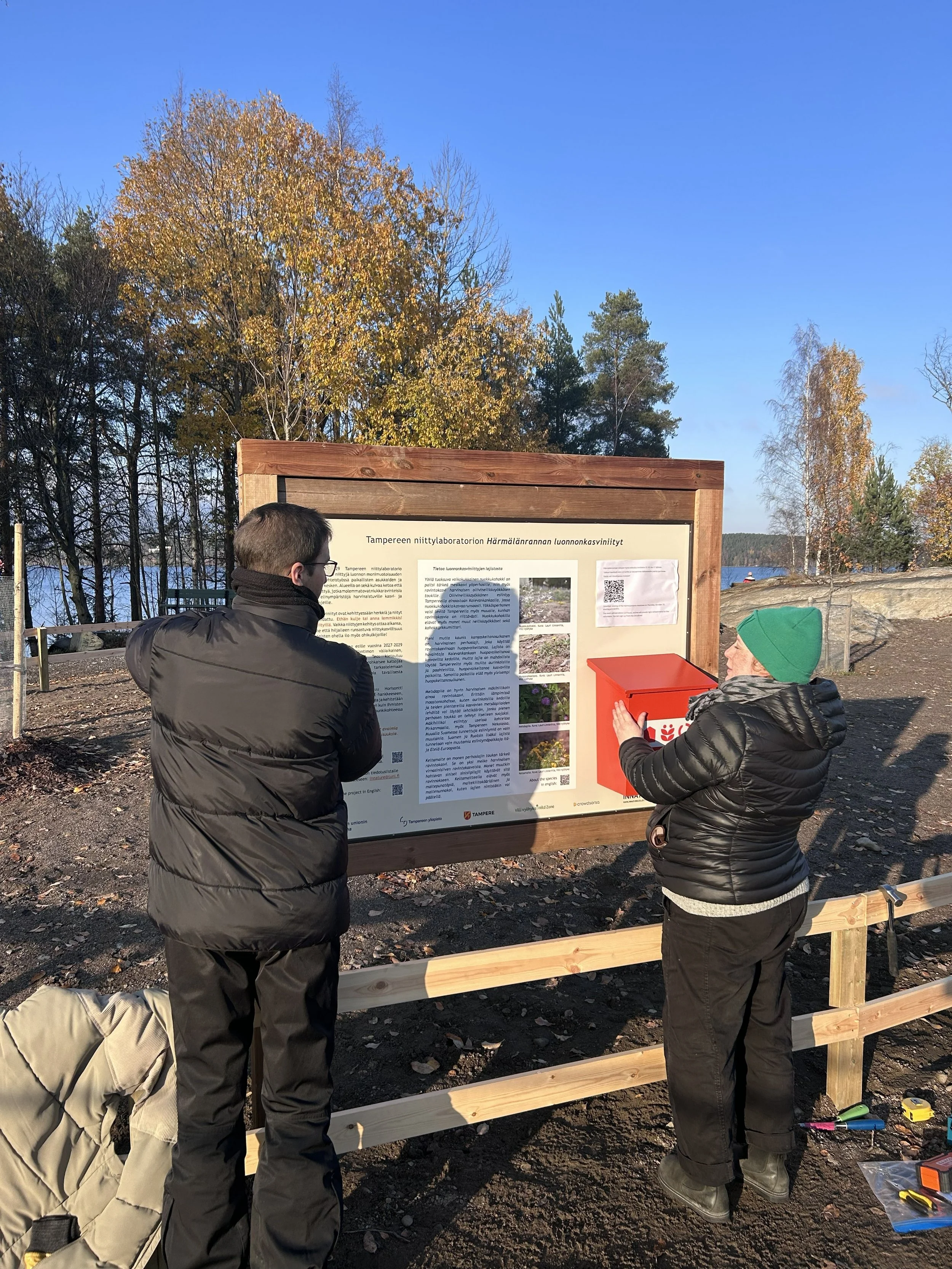
The newly installed signs in both places will share updates on the plants and future events. Photo Joona Lukka.
In Härmälänranta we ended the day with sandwiches and hot juice outside, topped with home garden apples. It is beautiful how one becomes attached to these places immediately. There comes the wish to act for them, to protect, to keep them clean. Plenty of meaning is already there. I do remember where I spread the seeds, and who were close by doing the same. I also gained a new favourite plant, the one that opens its flowers for the night pollinators, smelling strong like hyacinths. It will be great to follow how the plants take on.
Written by: Elina Alatalo
Architect, researcher at Politics of Nature and the Environment
Tampere University